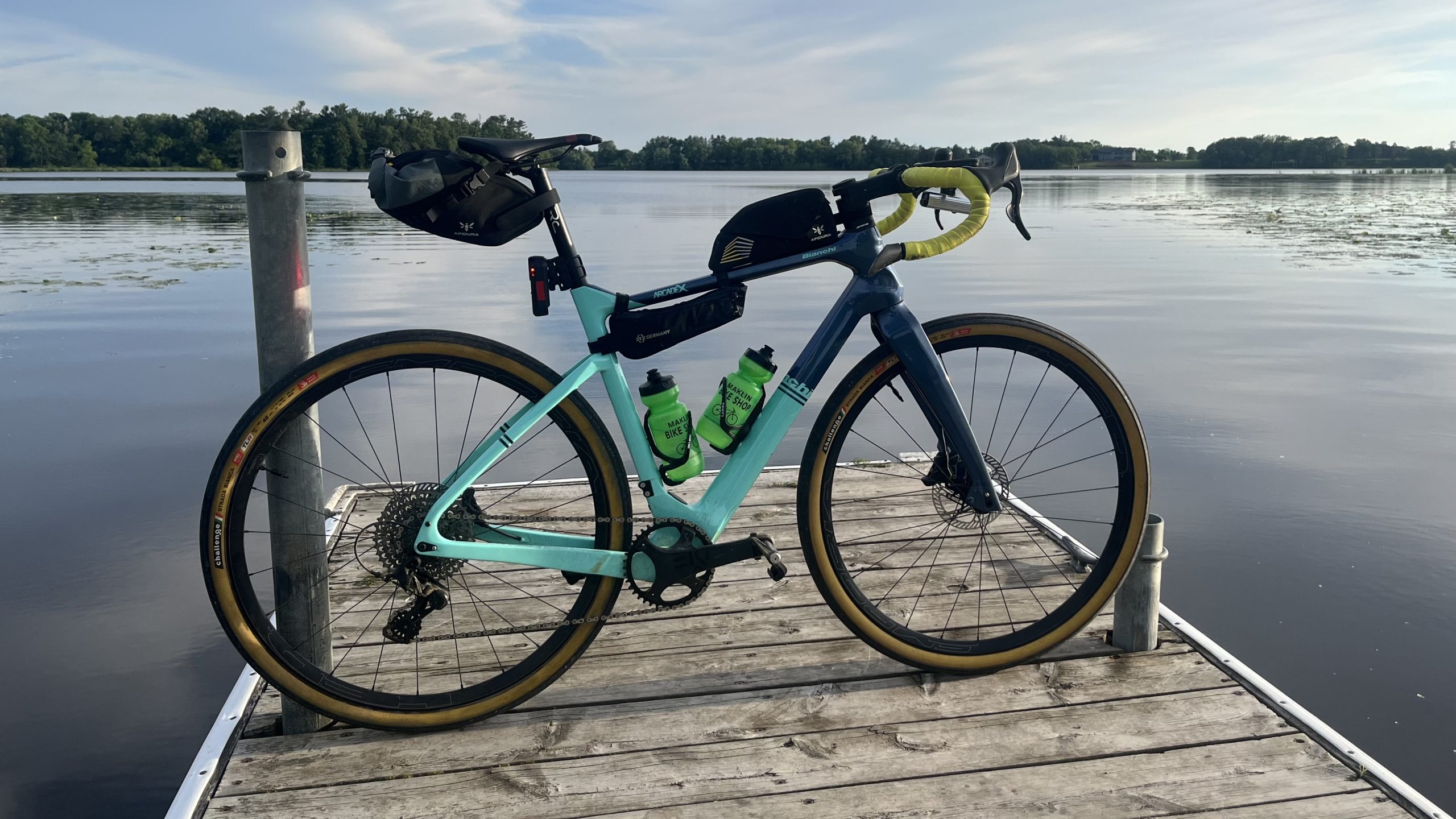
Steve put about a month and a half of riding on the previous-generation Bianchi Arcadex, including two gravel races — the Freedom 76 and the Badlands Gravel Battle. It runs Campagnolo Ekar 13-speed, HED Emporia GA Pro wheels, and 45mm Challenge Strada Bianca tires.
Drivetrain
The Arcadex here runs Campagnolo Ekar 13-speed. Steve really likes this drivetrain — it’s not perfect, but none of them are. For a rider into mechanical 1x, the Ekar has the best range and the tightest gear-step granularity of the 1x options out there, in his view, and once it’s set up and tuned it shifts great (the barrel adjuster gives you near-infinite fine adjustment).
These bikes come stock with a 10–44 cassette. Steve runs a 9–42 with the stock 40T chainring. Around here a 42T or even 44T chainring would still leave plenty of gear; he rarely needed the 40/42 low combo at the Badlands, though it earned its keep late in that ride with all the climbing. The 9-tooth small cog adds a little top-end speed when you want it.
Brakes
Out on the bike the Ekar brakes are excellent — lots of power and great modulation. They feel different from Shimano or SRAM when you’re first setting them up and bleeding them, but in use they’re among Steve’s favorites. The one issue: the calipers don’t deal well with wet dirt. In rain or wet gravel, grit packs into the caliper and grinds — it gets loud, and it needs flushing out. He hasn’t run into that with SRAM or Shimano. Wet gravel is hard on any brake, but this one seems more prone to it.
Wheels & Tires
Stock, the Arcadex comes with a Fulcrum wheelset — not the lightest, not unreasonably heavy. Steve swapped to HED Emporia GA Pro aluminum wheels, which the shop has run for years and considers one of the best aluminum gravel values out there.
Bianchi rates the frame for 42mm tires. Steve runs 45mm Challenge Strada Bianca handmade tubeless, which measure close to 48mm on the HED rims. There’s noticeably more clearance up front than in the rear — he’s cheating the rear a little, but there’s still ample room and he isn’t worried about it. He wouldn’t run a 45mm knobby back there. The handmade TLR tires aren’t as hard to mount as their reputation suggests — a little technique and they go on fine.
Steve has run this tire in 33, 36, 40, and 45. The 40 is his all-around favorite; the 45 drags a touch more but floats better in loose, soft gravel while still rolling well on pavement.
Fit & Feel
The stock bars came off in favor of Easton EC90 AX carbon — a shop favorite — wrapped in Lizard Skins 3.2 tape. Steve doesn’t love wrapping Lizard Skins (it isn’t meant to stretch), but the finished feel is excellent — good enough that he can ride without gloves, which is unusual for him.
The Arcadex draws mixed reviews online for its “tall but short” fit — a generous stack with a fairly short reach. For Steve it works out well: he’s long-legged with a shorter torso, so he runs a high seatpost and still gets plenty of drop to the bars. He’s also not chasing the current trend of long, slack, mountain-bikey gravel race bikes — a lot of riders going to gravel events aren’t actually looking for a slammed race rig. This one is comfortable enough to ride for hours, and it’s one of the more distinctive-looking bikes he’s spent time on, right down to the big-but-narrow fork.
A distinctive gravel bike with a drivetrain almost nobody stocks
The Arcadex is comfortable, capable, and genuinely different from the other gravel bikes Steve has put miles on. The Ekar 13-speed is the standout — smooth, wide range, mechanical simplicity — with the one knock being how the brakes handle wet grit. The frame has more usable tire clearance than its rating suggests if you’re willing to push the rear a little. Brought in on closeout and ridden hard as a demo, it earned its way into being a bike Steve kept reaching for.
Questions About the Arcadex?
Steve has put real miles on this one. Come by the shop in Scandia, MN, or reach out.