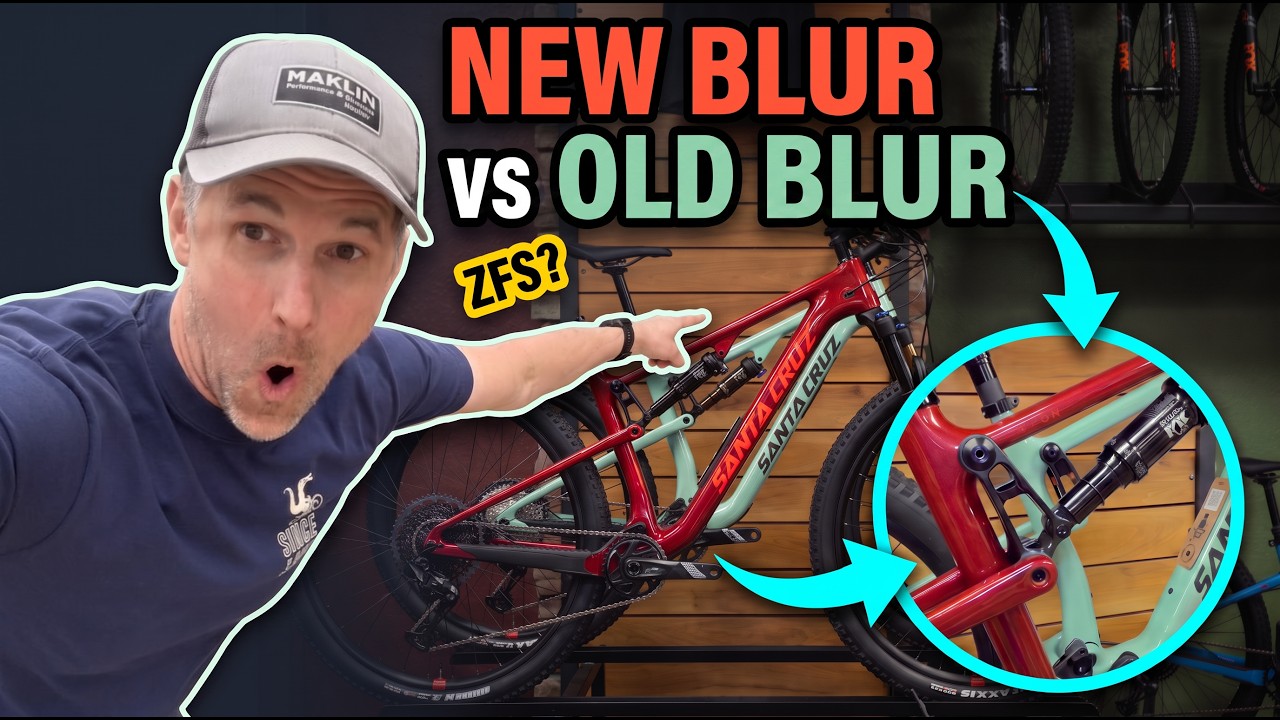
Santa Cruz has moved the Blur from its fourth generation to its fifth, and the new bike is slacker, longer, and lower. With a couple of the outgoing Blur 4s still on the floor next to a new Blur 5, Steve walked through every change frame-to-frame — geometry, suspension, storage, builds — and where the now-discontinued Cervelo ZFS-120 fit into the picture. This is a first look before the ride miles go on; a full ride review follows this fall.
- Slacker, longer, lower: 66° head angle (was 67.1°) and a 21mm-longer wheelbase — more stable and capable on rowdier trails.
- More progressive rear end: a longer link adds mid-stroke support and bottom-out resistance.
- Better frame: in-frame “glove box” storage, an accessory mount, fully lined internal routing — and still two bottles inside.
- Now 120/120 only: no more 100/110mm XC-race build — it’s a 120mm bike still set up for XC racing.
- The trade-off: the lower bottom bracket puts you a few millimeters closer to a pedal strike.
- Still a race bike: endurance XC / down-country plus marathon events (Little Sugar, NUE, Marji Gesick). The outgoing Blur 4s are a good deal on the way out.
Geometry — Slacker, Longer, Lower
One caveat up front on the comparison: the numbers below use the previous Blur 4 Trail build as the reference, because the Blur 5 no longer comes in a 100mm or 110mm XC-race configuration. The Blur 5 is a 120mm front / 120mm rear bike, full stop — so what the shop now has is effectively a 120mm bike still set up for XC racing.
| Spec | Blur 4 (Trail) | Blur 5 |
|---|---|---|
| Head tube angle | 67.1° | 66.0° |
| Reach | 438 mm | 450 mm |
| Stack | 597 mm | 588 mm |
| Wheelbase | 1,157 mm | 1,178 mm |
| Bottom bracket drop | 33 mm | 38.5 mm |
| Chainstay | 433 mm | 435 mm |
| Front / rear travel | 120 / 115 mm | 120 / 120 mm |
| Seat tube angle | ~75° | ~75° |
Medium-frame figures. Seat angle is effectively unchanged at about 75 degrees across the range.
The headline is the head tube angle: 67.1° on the Blur 4, 66° on the Blur 5 — 1.1 degrees slacker. That stretches the wheelbase by 21mm (just under an inch), for a bike that’s a little more stable at speed on rowdier trails. The seat tube is about an inch shorter, and the bottom bracket sits a little lower — you settle into the frame a touch more. It’s only a handful of millimeters, but it does put you roughly 5mm closer to a pedal strike, which is the trade for the lower, planted feel. Steve’s genuinely curious how the lower BB plays out for punchy XC racing; for all-around trail riding and more playful descending, it’s a clear win. Crank lengths reflect that too — the small ships with a 165mm crank, the rest of the sizes with a 170mm.
Where the ZFS-120 Fit
Worth a note for anyone cross-shopping: the Cervelo ZFS-120 — now out of production — shared a lot with the Blur, which makes sense, since both brands sit under the same parent company and the ZFS was clearly a rider-tuned tweak off the Blur platform. Not the same bike, but close. On reach, the ZFS-120 landed nearer the Blur 4 than the new Blur 5. Its stack was similar to the Blur 4 — taller than the Blur 5 — while still running 120mm up front. Seat angle was the same ~75°, and rear travel was 115mm, matching the Blur 4 Trail rather than the Blur 5’s 120mm.
Want to line the numbers up yourself? The Blur 4, Blur 5 and hundreds of other bikes are in our free Bike Geometry & Fit Tool — put them side by side and see exactly how the frames compare in your size.
Suspension
The rear shock itself carries over — a 190mm eyelet with a 45mm stroke. What changed is the linkage: the rocker link on the Blur 5 is about 8–9mm longer than the Blur 4’s, which raises the leverage ratio slightly and makes the bike a bit more progressive. In practice that means more mid-stroke support and a little more bottom-out resistance deep in the travel.
The Frame
The biggest visible change is in-frame storage — the new Blur 5 gets a downtube “glove box” compartment. Not a make-or-break feature for everyone, but a genuine nice-to-have; it’s a natural home for a spare TPU tube. There’s also a new accessory mount up top, sized like a bottle-cage mount, for a multi-tool, CO2, or whatever you want to carry on the frame. And it still takes two bottles inside the front triangle — same as the Blur 4, and a real deal on a full-suspension bike.
Routing is cleaner. The old frame was open inside with no housing tube to feed cables through; the new frame has fully lined internal ports, so shift cables and brake lines feed in and pop out exactly where they need to. Only the chainstay run is unlined, and even feeding from the back end everything comes out where it should — Steve’s built a few now and says it’s genuinely not a hassle. Both frames use a threaded bottom bracket, both still run a mechanical derailleur if you want one, and there’s clearance for a 36T chainring (a 34T is what’s on this build).
Weight
Steve weighed the shop’s medium SRAM 90 build against a medium SRAM 90 of the old bike, and they came out the same — 28 lb 3 oz apiece with tubes in, which drops into the 27-pound range once they’re set up tubeless (Santa Cruz’s spec sheet lists the medium SRAM 90 around 27.5–27.75 lb). The wrinkle: on the Blur 4, the entry-level builds used a heavier carbon layup, whereas every Blur 5 build now uses the nicer, lighter CC carbon. So the frame itself is likely a touch lighter — the glove box compartment and the carbon structure around it (plus the lined internal routing) probably add back the grams saved elsewhere.
Builds & Value
Steve’s take on the lineup, and how the shop plays off it:
- SRAM 90 — the bang-for-the-buck build, and where most buyers in this range should look.
- The GX AXS move — it’s simple to turn a SRAM 90 into a GX AXS bike with an upgrade kit for around $600, versus roughly $1,200 to jump to the factory GX AXS build (which lands you near $7,000, still without carbon wheels). For most riders who don’t need the minor brake and shock upgrades, the upgrade-kit route is the smarter spend.
- Race builds — in place of the old XC builds, there’s now a GX AXS race build with Reserve wheels and shock lockouts. But at that price, Steve would look hard at an XO build with carbon Reserve wheels for about $1,200 more — he’d rather spend up to the XO, which he finds shifts crisper and dials in better.
- Deore ($4,899) — only about $900 less than the SRAM 90. Steve would pay the difference for the SRAM 90 with Fox suspension every time; the upgrade path is better from there.
- Top end — XTR Di2 (DT Swiss 180 hubs) and an XX Flight Attendant build up around $13,000. Higher-end bikes the shop tends to custom-build anyway, since a buyer at that price usually wants specific touches.
Reserve carbon wheels are a straightforward add to any of these — a lot of plug-and-play either way.
Tires
The Blur 5 ships with Maxxis Aspen AT (All-Terrain) tires; the Blur 4 came with Maxxis Recons. Steve doesn’t run Recons — he’s ridden them, and they don’t roll as fast as what he likes — so he’s keen to get some miles on the Aspen ATs to see how they feel.
Who It’s For
This isn’t purely a short-track XC racer’s bike anymore — unless that racer also wants one do-everything bike for mild trail riding, in which case it fits nicely. Where Steve sees it landing is the endurance XC / down-country slot while still being a punchy race bike: marathon XC events like Little Sugar, NUE races, Marji Gesick, the Mohican 100, True Grit. It belongs on the weapon-of-choice list alongside something like a Salsa Spearfish. Steve’s own verdict: “This is my XC bike” — he loved the ZFS it effectively replaces, and the Blur 5 slots right into that role.
A longer, lower, more capable Blur — still a race bike
The Blur 5 is slacker, longer and lower than the Blur 4, with better in-frame storage, cleaner routing and a slightly more progressive rear end — a more capable 120mm bike that’s still a legitimate XC and marathon race weapon. The outgoing Blur 4 Trail bikes on the floor are going to be a good deal on the way out. Steve will be putting fall miles on the Blur 5 and circling back with a full ride review.
Interested in a Santa Cruz Blur?
We carry Santa Cruz at Maklin Bike Shop and build every one in-house. Reach out to talk builds, sizing and availability.