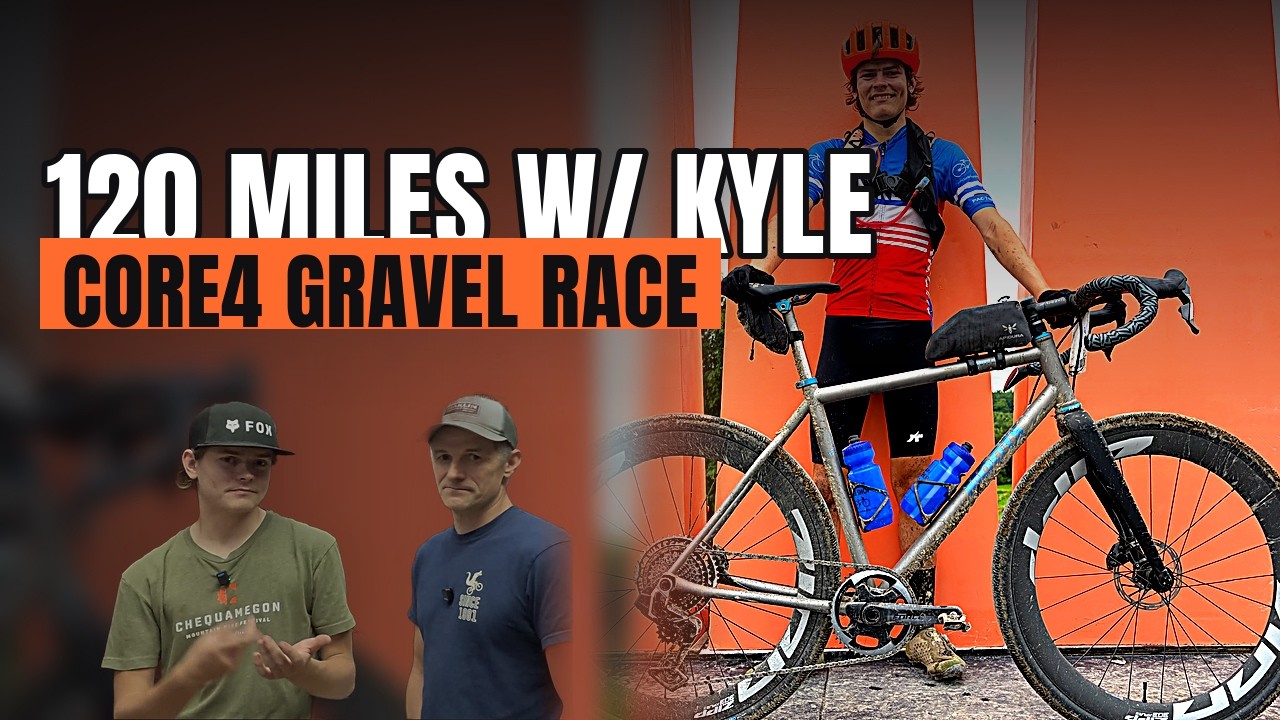
Core4 is a mixed-surface gravel race in Iowa City, Iowa, built on a “no surface untouched” idea — gravel, B roads, pavement, singletrack, even a waterfall-style spillway crossing and a cyclocross run up a set of stairs. It runs several distances, each on its own course, from a 120-mile event that’s a stop on the Gravel Earth Series down to a USA Cycling junior 60-miler. Maklin riders Kyle and Reid both raced it in 2026.
At a glance
| Location | Iowa City, Iowa |
| Discipline | Gravel (mixed-surface) |
| Distances | 120 mi (Gravel Earth Series), 70 mi, 60 mi (USA Cycling juniors), 40 mi, 20 mi |
| Series | Gravel Earth Series (120); USA Cycling Gravel Junior calendar (60) |
2026
2026 was a wet edition. Thunderstorms and heavy rain the day before pushed organizers to run alternate courses — packet pickup went drive-through, most of the singletrack and the worst of the B roads were cut, and a stretch of trail too wet to ride became a roughly 1,000-foot run-with-your-bike section. Both Maklin riders liked the call; it kept the race from turning into a bike-wrecking mud slog. Kyle raced the 120-mile Gravel Earth Series event in the pro field; Reid raced the USA Cycling junior 60-miler.
Results
| Kyle | 19th, pro field — 120-mile Gravel Earth Series (first time racing the pro field) |
| Reid | 13th overall, 7th of the 17–18 age group — USA Cycling junior 60-miler |
Bike setups
| Kyle | Bike: Moots Routt RSL (shop demo) · Drivetrain: SRAM Force XPLR 13-speed, 46t chainring, 10–46 cassette (swapped up from the stock 44t) · Wheels: Zipp XPLR 303 · Tires: Schwalbe G-One RS Pro 45 (measured 47) · Bag: Apidura top tube (Wolf Tooth B-RAD bolt-on adapter) · Off-road pedals for the run sections |
| Reid | Bike: Cervelo Aspero-5, size 54 · Drivetrain: SRAM Force XPLR 13-speed, 48t chainring, 10–46 cassette (swapped from the stock mountain cassette) · Wheels: Reserve GR40 44 (stock) · Tires: Continental Terra Speed 45 |
Before the race, we did a full bike check on both setups and the wet-course tire-clearance decisions behind them.
Kyle’s race — 120-mile, pro field
Kyle signed up for the pro field for the first time — not expecting to contend, but to find out where he stood against that level and set up for more of it next year. The pro and open fields started together in a mass start, with the pros getting a quarantined front spot for the neutral rollout.
The first B road came about three and a half miles in, off a left-hand turn, where a crash went down on the inside; Kyle was on the outside and got through clean. A group of 40 or 50 entered the B road together — wet but not tire-clogging — and for a moment Kyle found himself right on Dylan Johnson’s wheel, coming out of one of the puddles just ahead of him. It blew apart from there: a lead group went up the road, then a chase group with Johnson and others, and Kyle settled into the group behind.
The alternate course threaded three river/stream crossings — including the slick, algae-covered spillway where one of the leaders broke a wheel — a stair carry on a wooded hiking trail, the mandated run section, and a long stretch winding through Iowa City neighborhoods and bike paths. Around mile 55, on a hill, the group attacked while Kyle was on the front; he didn’t see it coming and couldn’t grab the wheel as they came by, and rode solo for about 15 miles. He linked back up with faster riders coming through, took a bottle and hydration-pack hand-up from Steve at mile 77, and traded off with a couple of riders — including a single-speeder who dropped the group and then got caught again — the rest of the way in. He finished 19th in the pro field, with the DNFs behind him and just ahead of 10th in the open field, closing with a cyclocross-style grassy finish and an attack up the final hill.
The power picture
The interesting part: Kyle cramped throughout, yet the power file says he never overcooked it. Broken into 10-minute windows, he never went over FTP the entire race — the opening 10 minutes were only about 86% of FTP. His best short efforts were a 718-watt five-second and a 462-watt 30-second, with a 5-minute best of 312 watts, barely over threshold. Average power was 176 watts; weighted (normalized) power 205. By the hour it drifted down and then rallied: 247, 220, 206, 177, 175, 185, with the final 30 minutes at 195 and a last-10-minute spike to 271 — legs at the end, held back all day by cramps that the numbers alone don’t explain. Fueling wasn’t the culprit (see below); the cause is still an open question. We broke the file down with our Ride Autopsy tool.
Nutrition: for the first 77 miles, about 400g of carbs in a hydration pack (five 80g SIS Super Fuel packets) plus two bottles of water; a fresh pack at mile 77 with three ~59g Gu packets; and six 25g unflavored carb gels across the whole race. Loaded early, and it held up.
Reid’s race — USA Cycling junior 60-miler
Reid’s race was the USA Cycling 60-mile junior course for 15-to-18-year-olds, a stop on the USA Gravel Junior National calendar and his first on that calendar. His course was simpler than the 120 — mostly standard gravel with a couple of B roads and pavement, no waterfall, singletrack or stairs. About 20-some riders started together.
Off the neutral pavement rollout out of the orchard, the race strung out as soon as it hit gravel. Reid got caught toward the back and dropped about a mile in, then clawed back to the lead group on a fast downhill — hitting 39.7 mph to do it, helped by having enough gear to keep pedaling where others spun out. He came off for good around mile nine at the start of a hill, just before the first B road at mile 10, which was muddy enough that he slid out twice on the Terra Speeds. After a few miles solo, a group of four caught him and they traded turns for a long stretch; around mile 45 another rider joined, the group strung out on a hill, and that’s when Reid started cramping hard. He struggled the last 10-plus miles to the same cyclocross-style grassy finish, taking 13th overall and 7th in the 17–18 age group.
The power picture
Reid’s file is the opposite story from Kyle’s — he went out too hard. His first 10 minutes averaged 304 watts, the first 15 averaged 293, and he was still at 272 at the 30-minute mark, all around or above an FTP of roughly 265. As Steve put it, he ran an FTP test at the start of a three-hour race, chasing a stronger front group before he knew where he stood. Power fell off a cliff after that first half hour, recovered into the low 200s for a stretch, then sagged again — down to 15-minute windows around 170 and later 150 watts near mile 50 — with a last 15 minutes averaging 167. The cramping that hit around mile 45 traces straight back to that opening surge. Our Ride Autopsy tool flagged the first-20-minute effort as the mistake of the ride.
Reid is no stranger to distance — he rode the DAMn (240-plus miles) last year and has finished multiple 100-mile gravel races — but this year’s volume has been light, which made the too-hot start cost more than it might have. He’d only been on the Aspero-5 a couple of weeks before the race, after the shop sold its last demo Asperos and he moved onto one of the shop’s personal bikes.
Both riders, same lesson
Two very different power files, two cases of late-race cramping — Kyle’s despite conservative power, Reid’s after a hot opening. Both are exactly the kind of ride worth breaking down after the fact. Next up for both: Gravel Nationals, then Cheq 40 — with bike checks to come.