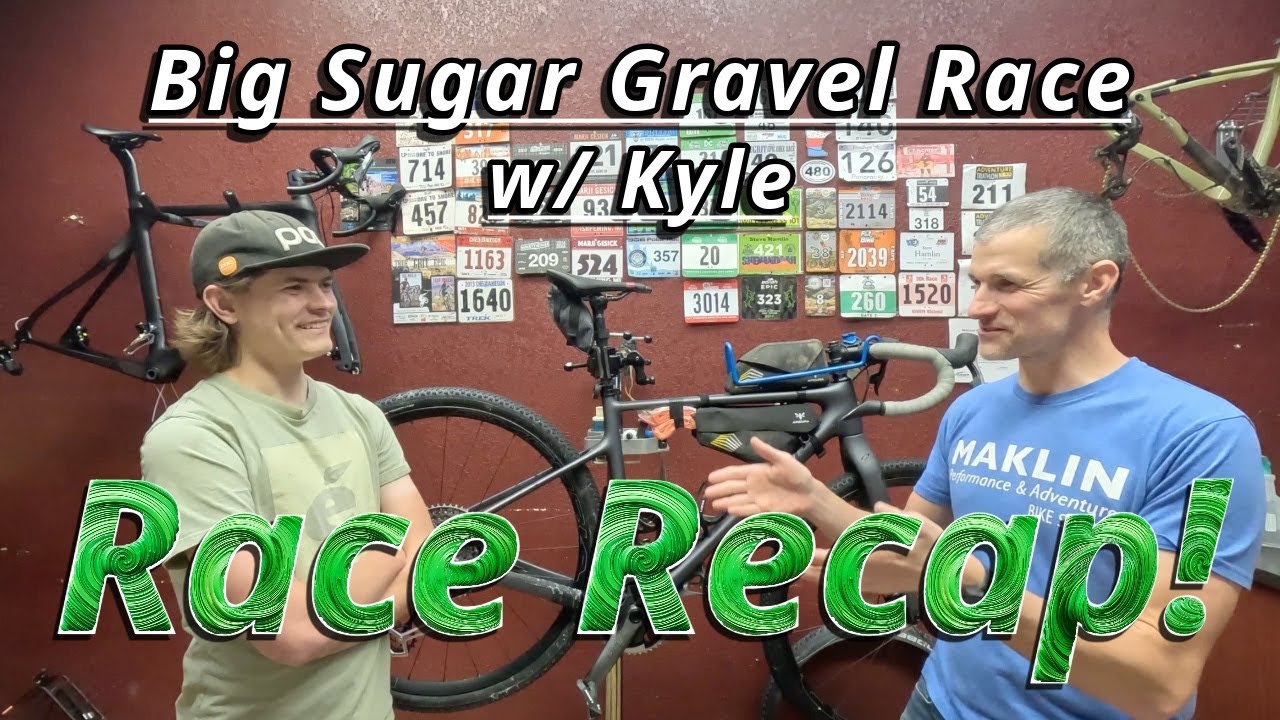
The Big Sugar Classic is a gravel race in Bentonville, Arkansas – the gravel centerpiece of Big Sugar week and a Life Time Grand Prix stop. The full route is 100 miles of Ozarks gravel, known for chunky, rock-strewn roads rough enough that much of the field lines up on mountain bike tires.
At a glance
| Location | Bentonville, AR |
| Discipline | Gravel |
| Distance | 100 miles (shortened to ~50 in 2025) |
| Series | Life Time Grand Prix |
2025
Storms shortened the 100-mile race to roughly 50 miles in 2025 – the call came the morning of the race.
Results
| Kyle | 99th overall, 9th of 17 in 19 & under – 2hr 52min, 18.83 mph avg |
| Reid | 216th overall, 12th of 17 in 19 & under – 3hr 3min, 17.6 mph avg |
Bike setups
| Kyle | Bike: Niner ORE · Drivetrain: SRAM mullet – 46t 1x, Force levers, XX Eagle AXS transmission (10-52) · Tires: Vittoria Terreno T70 45 · Sealant: ~16 oz/tire |
| Reid | Bike: Jamis Renegade · Drivetrain: Shimano 2×11 · Wheels: front swapped to HED Emporia (toasted hub bearing) · Tires: Continental Terra Trail 45 · Sealant: ~12 oz/tire |
Kyle’s race
The Big Sugar Classic in Bentonville, Arkansas, was supposed to be a 100-mile gravel race, but a storm forced organizers to shorten the 100-mile races to roughly 50 miles. The change wasn’t confirmed until the morning of the race. The Big Sugar account had warned on Instagram on Friday night that the course could change, so Kyle loaded the 50-mile course that evening. Course-change news was promised by 6:30 a.m. and any delays by 7:00; the call came right around 7:00, “like five minutes after or so,” with Kyle’s race set to start at 7:50.
The shortened course also changed the start completely. The 100-mile race had been routed out of town in the other direction, so the first 30 miles were new ground for Kyle and most of the field. From the gate the race “pretty much went straight” before a short, sharp left that went smoothly. Things got chaotic at a left-hand turn with “road furniture” on the inside, the triangular curb islands common around Bentonville, and again at a roundabout where riders were splitting left and right. The opposing-lane traffic that had been an issue in the pro race was shut down by the time Kyle went through.
About two miles in, after bombing downhill on pavement, “gravel came out of nowhere. We just hit gravel doing like 25, 30.” That first stretch of gravel was downhill and off camber, and an off-camber right-hand turn caught several riders: “there was probably I think like five or so people that went down in front of me.” Kyle had to come to a complete stop but stayed upright, backed up, and went around.
The pace was fierce early. With everyone primed for a 100-mile day, the field went out hard; Kyle was “doing like 23 or something” for the first seven miles and at the 7.8-mile mark his average was over 23 mph, sitting 90th overall and 11th of the 19-and-unders. The field strung out into groups of ten or so. Kyle settled into a group of about 15, but on some long straights, “my legs were still pretty fatigued from the fast, crazy fast start,” and he got dropped off the back. Rather than chase, he eased up, latched onto a big group coming up behind, and rode with them; that group eventually caught the one that had dropped him.
Around 27 or 28 miles in, the weather hit: “It was just completely downpour and the skies were all black.” Turning onto the aid-station road near mile 30 meant a fast downhill in the pouring rain, the black sky, and the headlights of pro support vehicles coming back up the road, leaving riders hugging the right side, “going way slower” because it was “impossible to see anything.” Kyle carried enough on the bike to skip the aid station and ripped straight through. The downpour cost real speed: by mile 33 his average had dropped about four miles an hour to just over 19 mph, and he had slipped to 94th overall, 10th of the 19-and-unders.
From there the course matched the tamer final 20 miles Kyle had pre-ridden, with fun turns into gravel rather than the chunk of the 100-mile front half. Road crossings were mostly marshaled, though one came as “very chunky rocks” dropping “straight down to the stop sign” with no way to stop, just before a short single-track section. Kyle hit that single track in a group of 20 to 25, and by miles 42 and 45 he had dropped to around 100th. On the pavement that followed, “everyone was just recovering a bit.”
The race blew apart on the climb up to the overpass, the second-to-last climb, which Kyle had figured all along would be “the big decider.” As the group split, seven or eight riders broke away off the front; Kyle hooked up with a group of three while the rest got away. Over the overpass and down into the base of town, it was a climb of roughly two miles back up to the finish. On that final climb Kyle was “just hanging on,” tried to stand but “it didn’t work out,” and caught one rider who was fading into the line. The big group he had been with at the base of the decisive climb came through the finish shortly after him.
Kyle finished 99th overall in about 2 hours 52 minutes at an 18.83 mph average, and 9th of 17 in the 19-and-under field, out of more than 720 riders through the first split. He felt good about it and is already looking forward to the full 100: “It more fits my capabilities.” Given his results this year – 20th overall at the 240-mile DAMN and 36th at Little Sugar the weekend before – that read tracks; Kyle is a strong grinder, and the longer course should suit him.
Reid’s race
The Big Sugar Classic in Bentonville, Arkansas was supposed to be a hundred-mile gravel race, but the weather forced a change. As Reid put it, “It’s supposed to be a hundred miles, but due to some weather risks, they shortened it to 50.” The reroute meant the 50-mile course shared almost nothing with the hundred Reid had pre-ridden. As Steve noted, “the only part of the course that was the same would’ve been like the last 15 to 20 or something.” It also came the weekend after the Little Sugar mountain bike race.
The neutral rollout went off fast. “For the neutral rollout, I was pretty close to Kyle, starting right behind him,” Reid said, “and then noticed he totally messed up his clip in, so we just made sure to get around him and then kind of just kept trying to slowly work my way towards the front.” His legs felt good early – and then, about 20 minutes in, the bottom fell out. “My legs were feeling pretty good, and then all of a sudden they just like completely died,” Reid said. He faded back to the next group, saw Kyle there, and “just could not latch on at all.” His own read on it was blunt: “I went out way too hard.”
The numbers backed that up. Reid put down “like 300 watt normalized power for 20 minutes” – well above an FTP that had last tested in the 260s. “You effectively normalized power for 20 minutes above your FTP,” Steve told him. It was the same pattern as the Little Sugar race the weekend before, where Reid had set all-time power PRs from two minutes through ten at the start. As Steve put it, “Dude’s excited to race.”
Around mile 12 Reid went down. “It was a left turn, kind of like 90 degree left turn, not very chunky at all. Pretty smooth. I think I just was breaking too late,” he said, “and then kind of just slid on my stomach.” It wasn’t the off-camber right-hander where some of the pros crashed out – just a corner he overcooked. “I think I just overcooked it a little bit.” With almost 40 miles still to go, he picked himself up and pressed on, but the legs never came back. “Legs are just not really feeling it that day in general,” Reid said. “But I went out too hard too.”
From there it was a long grind. “From mile like 12 to like maybe mile 40 was kind of just slowly fading,” Reid said. The standings tell the story: he sat 68th at mile 7.8, then slid back to 207th by mile 33. Around the halfway point, the rain arrived. “I think we were hitting the rain through the aid station,” Reid said.
Reid kept at it through the back half, dropping and gaining a handful of spots, and he hammered the finish – a one-minute effort of 490 watts and a max of 881 in there at the end. He came across in about 3 hours 3 minutes at a 17.6 mph average, good for 216th overall and 12th of 17 in the 19-and-under field. His average power for the race was 212 watts, with a weighted average of 231 – a day defined far more by that opening 20 minutes than anything that came after.
The plan for next year is simple. Asked if he wanted to go back and take on the full hundred-mile course, Reid didn’t hesitate: “Yeah, yeah, yeah, for sure.” Little Sugar and Big Sugar again, the full distance this time.