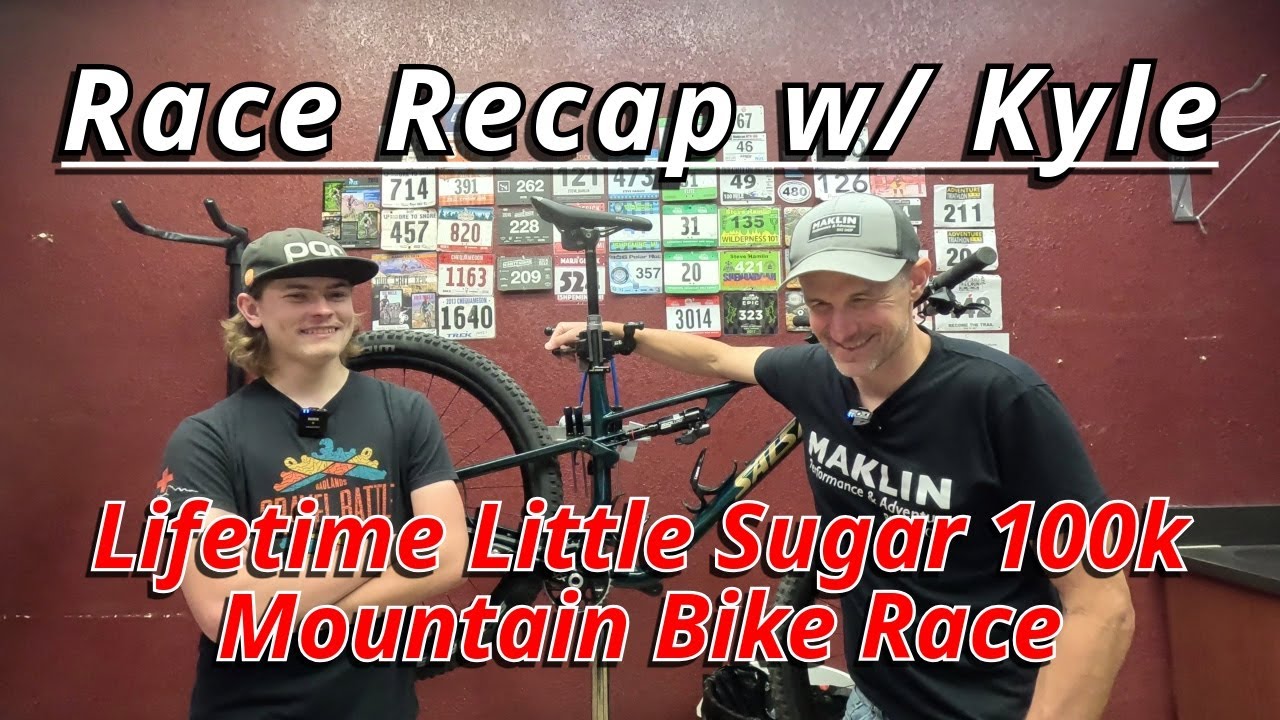
The Little Sugar is a 100K (61-mile) mountain bike race in Bentonville, Arkansas, held in October as part of Big Sugar Classic week and a stop on the Life Time Grand Prix. The course runs the Bentonville trail network – mostly singletrack through Ozarks terrain with bluff lines, caves, waterfalls, and the technical Ledges section in the back half. It is about as technical as an XC race gets at this distance.
At a glance
| Location | Bentonville, AR |
| Discipline | Mountain bike |
| Distance | 100K (~61 miles) |
| When | October |
| Series | Life Time Grand Prix |
Results and Race Recaps
2026
Results
| Kyle | 69th overall, 6:07 – a top-100 finish, and about 22 minutes slower than his 2025 ride |
| Reid | Finished ahead of Kyle this year (a full recap with Reid is coming) |
Bike setup
| Kyle | Bike: the new Santa Cruz Blur (a flex-stay bike, built up from a SRAM 90 build with the shop’s own parts swapped on; base performance suspension, not Flight Attendant) · Drivetrain: SRAM XX, 34t chainring (ran a 36t in 2025) · Tires: Schwalbe Nobby Nic (f) / Wicked Will (r) – a heavier, luggier choice for Bentonville’s sharp rock · Fuel: SIS high energy mix with an electrolyte mix, plus carb gels |
Kyle’s race
Kyle, 18, came back to the Little Sugar 100K for a second time in October 2026 – roughly 61 miles of Bentonville, Arkansas singletrack, most of six hours of racing. The 2026 course started at the new Oz Trails Bike Park, climbed a steep pavement wall right off the start, ran the Little Sugar trail system, crossed at the Lumberyard into the Back 40 and its Ledges features, dropped through Blowing Springs and a new section across the expressway, hit the tight-and-chunky Handcut Hollow, and finished with about a mile of blocked-off city streets and a road climb to the line. As Kyle put it, there is almost no flat singletrack out there: “You’re either going up or you’re going down.”
Unlike 2025, there was no easing into it. After an eighth to a quarter mile of road, the race turned straight up a pavement climb. Kyle and Reid lined up near the front, and Kyle went well over threshold trying to hold the leaders – about two and a half minutes at 350 watts. “I tried my best to stay with the front going up it, but I got dropped off of it, but then I was able to get back on some of the short downhills by using some draft behind people.” Out of the bike park at mile 5 he was sitting 22nd.
Then it never let up. Straight off the hard climb the course went into relentless, up-and-down, chunky singletrack with no chance to settle, and Kyle’s heart rate never came back down. Steve’s read, looking at the file afterward, was that nerves plus limited time on singletrack this season had Kyle riding wheels he probably should not have been on early, with his heart rate pinned near threshold from the gun. It is the kind of thing the shop has started leaning on heart rate to catch. As Steve put it, “A lot of people will say you don’t need a heart rate monitor when you use power, and I feel like we’ve been learning more and more” that tying heart rate to power is what flags a day going sideways early. Around mile 18 to 20, it did: “I could tell at like mile 18, 19, I messed up something in the singletrack, and then a quick jolt and all of a sudden I could feel my legs were not in a great place.” The placings slid with it – 22nd at mile 5, 33rd by mile 13, 50th by mile 24.
At the mile-26 Lumberyard – the only crew stop in the age-group race – Steve handed up bottles, and Reid pulled in right behind Kyle. Shortly after, things came apart: Kyle fumbled a rooty drop, slid off the side of the trail, and his legs locked up completely. “All of a sudden my legs just fully locked up and I couldn’t unclip.” He stopped a few more times after that, though not for as long.
Two things went wrong on the fueling side. The hydration pack had been mixed heavier than usual – about a bag and a scoop more powder than Kyle had ever run – then filled with ice, and it gelled up: “It was plugged. I couldn’t really get anything out of it, and if it got anything out, it was just big chunks.” He dumped it and refilled with plain water at the neutral aid, topping his two bottles again before Ledges, and leaned on carb gels, which the brothers had started using and liked this year. The other issue was the power meter, which dropped out mid-race – connected but reading no power – so the back-half power file is not much use.
Power had faded hard after the first hour, but Kyle did not pack it in. He fought the last hour and a half, and his strongest trail of the day was the one near the end: Handcut Hollow, tight and chunky but fast, “kind of reminded me a little bit back home in Minnesota, but just chunkier.” The placings tell the gut-it-out story – he left the Lumberyard 50th, slid to 74th by mile 34 and 83rd by mile 43, then clawed 11 spots back by Blowing Springs around mile 52 and kept pulling people back to finish 69th in 6:07. It was about 22 minutes off his 2025 time, and still inside the top 100.
Steve was candid that it was not the ride Kyle wanted, but he was proud of how it ended: “I was super proud of Kyle – he never gave up, and you could see in his heart rate profile that he was just picking up steam the last hour and a half,” knowing he just had to grind it home. The takeaways were the honest kind – the hot opening and nerves on unfamiliar, technical singletrack, a fuel mix changed at the wrong time, and a tire call (heavier and luggier for security over speed) that cost the least of the day’s time. The 34t chainring, down from a 36t in 2025, was the right move. More time on singletrack – and maybe a faster tire – are on the list for a third year.
On the bike itself, Kyle was unequivocal: “Oh, I love it.” A full, dedicated look at the new Blur is still to come – Steve has been off the mountain bike with a separated shoulder and wants to ride it back to back against the Salsa Spearfish Kyle raced here in 2025 (and his old Cervelo ZFS 120) before putting a verdict on it, possibly with a Flight Attendant suspension swap in the spring.
Fuel / hydration
Kyle
SIS high energy mix with an electrolyte mix in the hydration pack, plus carb gels. The pack was mixed heavier than usual (about a bag and a scoop more powder) and iced, and it gelled up and clogged – dumped and refilled with plain water at the neutral aid, with two bottles topped off before Ledges. Lesson for next time: do not change a mix that works, and consider making a gel-strength bottle with plain water in the pack.
Strava
Kyle
Reid
2025
Results
| Kyle | 36th overall, 7th in 19 & under (353 finishers, ~428 starters) |
| Reid | 81st overall, 15th of 23 in 15-16 age group |
Bike setups
| Kyle | Bike: Salsa Spearfish (Salsa demo loan – came as an X0 Flight Attendant build, swapped to an XX build for the race) · Drivetrain: SRAM XX, 36t chainring (would run 34t next time) · Wheels: own older carbon set (kept the demo wheels off) · Tires: Schwalbe Nobby Nic (f) / Wicked Will (r) · Sealant: 16 oz/tire |
| Reid | Bike: Niner RKT (family trail bike) · Drivetrain: SRAM Eagle XX1 AXS · Wheels: Reserve 28 · Tires: Maxxis Rekon (f) / Schwalbe Wicked Will (r) · Sealant: 16 oz/tire · Extras: Wolf Tooth grips, spare tubes, 2 plug kits |
Kyle’s race
Kyle, 17, lined up for the Little Sugar 100K, a roughly 61-mile mountain bike race on the technical Ozarks singletrack in Bentonville, Arkansas, in October 2025. It was his first real time riding Bentonville that he can remember. As Steve put it, “it’s pretty much all single track,” with only a short stretch of bike path mid-race and “pavement at the end.” The course had taught the family a hard lesson during pre-rides: Reid slashed a tire and cracked a rim about five miles in on day one, and Kyle cut his rear sidewall around 15 miles in on day two. Both came away knowing they “needed a thicker tire and a lot of sealing” for race day, choosing to err on the side of finishing over fixing flats on the side of the trail.
The start nearly caught Kyle and Reid off guard. Sitting at a picnic table, they assumed the riders stacked at the gate were the pro field. “Then we realized that the pro fields were already lined up way up the start gate, and that massive group of people was actually in our race.” With 400-plus riders in an open, free-for-all start, they scrambled into line, but the gate position was deep, Kyle around 150 to 180 back and Reid a couple hundred deep.
The rollout ran about two miles of pavement before a left turn up a steep grass hill into the singletrack. Kyle used that hill to move up: “I was able to make up a decent amount of positions up that hill,” closing a gap to Reid from about 15 riders down to two. By the 17.4-mile timing mat the brothers were wheel to wheel, and they rode together for “probably around 20 ish miles.”
The technical opening tested everyone. “You entered it and then it went immediately to downhill switchbacks,” with riders track-standing to get around them after someone slid out. Long single-file lines eventually broke into groups of 10 or 15. About 10 miles in, “someone did crash right in front of me, but I was able to get by them.” Flats were everywhere; at the first neighborhood road crossing “there was like four or so people just on the side trying to fix flats.” Through the rock-overhang section, Kyle was in a line of about 10 riders. The first overhang “went very smoothly. No one had to walk.” Then on a steep uphill, one rider’s tire slipped and repeatedly stalled the group, and Kyle himself bobbled a track stand: “I had to get off my bike, which then I got passed by five people or so.” He caught back up within a mile and came past a group of three.
The placings showed steady progress. Kyle was 60th at mile 6.8, up to 47th by 17.4 averaging 12.2 mph, and 43rd by the lone mile-30 aid station, where support was allowed and Steve handed up bottles. “Kyle came through just looking really strong. Didn’t really slow down,” Steve said, noting he was now inside the top 10 percent on a new course, on a bike he hadn’t been racing, after a season spent mostly on gravel rather than singletrack.
Around 39 miles in came Ledges, the technical crux: an exposed section out along a ledge with tight turns and rocky drops into creek crossings. Kyle entered in a group of three teenagers with another group of three or four chasing. “The first technical spot the two people in front of me, they were able to make it through. I got hung up on it,” and they got away, though he slowly reeled one back in. The hardest features beat everyone: “we were all walking those sections, none of us were able to ride.” No one in sight rode them. By mile 46, a couple miles past Ledges, his average had dropped to 10.6 mph and he sat 45th, four hours and 18 minutes in.
From there the course eased through green trails, a boardwalk zigzag out to a tight cliff ledge (“gotta watch your head for the rock above you”), and stretches of bike path. Kyle was still 45th at the mile-50.8 mat. Then the late charge began. After a quick top-off at a Shimano water station near mile 51, “I started hammering on the bike path to just get up to speed” and got away from his group. He linked up with another rider, passed a few more, and in the last five miles they “started coming by people in our race, pulled over, who were starting to feel the fatigue. They weren’t having mechanicals, they were just exhausted.” On the closing flow trail toward the finish, Kyle got away from a group of three on the downhill and held it to the line for a solo finish.
He picked up nine spots between mile 50 and the finish, including one or two in his age group in the final five miles, to finish 36th overall and 7th in the 19-and-under category. “Good job, man,” Steve told him.
Reid’s race
Reid, 16, lined up for the Little Sugar 100K, a roughly 61-mile mountain bike race on the technical Ozarks singletrack in Bentonville, Arkansas, in October 2025. He and Kyle pre-rode the course over three days, doing about 20 miles each day from the start through to the finish. The recon changed Reid’s expectations: “Pre ride definitely made me realize that the course is gonna be a little bit harder than I was anticipating.” Steve asked if he’d come in expecting something lighter, and Reid agreed it turned out tougher than he’d figured. The pre-ride also gave them a hard tire lesson – five miles in on day one Reid put two big slashes in a tire and dented the rim, which set their tire approach for race day.
On race morning the family watched the 50K riders roll out before Reid and Kyle realized they needed to get lined up. Reid started further back than Kyle – roughly six rows behind him in a field of 400-plus riders. During the neutral rollout he worked his way up: “I kind of just slowly worked my way up.” On the opening grassy climb he pushed hard, “going hard on the grass hill and then just settled in a bit ’cause just struggling to like breathe.” By mile 6.8 he was sitting 53rd overall and had gapped Kyle by about 30 seconds. Hitting the singletrack was tight wheel-to-wheel, and Reid got caught in an early backup where someone appeared to have slid out: “not the crash, the backup. I think somebody slid out.”
Once into the trail it settled into “one massive train for quite a while and then like eventually gap started to form and then kind of slowly pass a bit.” Around mile 17 Reid and Kyle were trading places – Reid led, Kyle got back around in a road opening – and Reid had moved up to 48th. That stretch included the front-half technical section with the cliff-ledge overhang. It was congested but manageable: “it was definitely tight, but if you just give people in front of you room, it’s not a big deal.”
About two hours in, things started to turn. Kyle pulled away and Reid began to fade as the day heated up: “Everything kind of started to overheat and then was struggling to stomach anything. Just having the urge of like, puking almost.” He gave up on his hydration mix and switched to plain water, filling bottles at the trailside pumps when he could. By mile 30 he’d slipped to 54th, and by mile 46 he’d dropped to 63rd.
Around the 50-mile mark came the Ledges section, the two out-and-backs. Reid didn’t get through it cleanly: “I definitely didn’t get through it very clean. Kept getting outta the way for people who were riding some of the stuff.” He explained how it compounds – “once you mess up one, it’s kind of hard to get back in like a clean line to clear any of the other ones.” Some sections were wet and he played it safe rather than risk it. By his own account, Ledges was where he gave up most of his places; the rest of the trail he was largely holding his own. By mile 50 he’d fallen to 69th.
From there it was a grind to the finish, riding mostly solo with the occasional rider working up and past him. Back on the town side and on the long climb up along the expressway, Reid kept slogging it through. On the final flow trail and the climbing singletrack to the line, fatigue caught up with his hands – “I was struggling with my hands a bit” – just worn out from a busy, on-and-off-the-brakes course. He missed a turn near the end and had to backtrack quickly, but there wasn’t much else to it: “wasn’t really much to happen.”
Reid crossed the line 81st overall out of 353 finishers, from a field of 428 that went through the first timing mat – a top-100 finish – and 15th of 23 in his age group. The power file helps explain the fade: at the start of a six-hour race Reid set all-time personal bests including a two-minute power of 436 watts on that opening grassy climb to fight into the singletrack, plus best efforts at three minutes (387W), five (332W), eight (315W) and ten minutes (297W). As Steve put it, “That might explain a little bit the fade after two hours.” His average power for the six hours and four minutes was 166 watts, with a weighted average of 202.
Fuel / hydration
Kyle
Hydration pack with SIS high carb mix – 5 packs (80g each, ~400g carbs total) in a 2L bladder. One bottle SIS mix on the bike, one plain water bottle. Clif Bloks (2-3 packs). Electrolyte bottle at mile 30 hand-up from Steve. Would do a cold hydration-pack swap at mile 30 next time instead of a refill.
Reid
Started with hydration mix, switched to plain water around mile 30 when his stomach went sideways. Filled bottles at the water pumps on the trail. Lost fueling in the second half – same issue as the DAMN.
Strava
Strava activities coming.